

Wastewater from Svalbard’s largest settlement, Longyearbyen, is released untreated into Adventfjorden through a pipeline. Denser anthropogenic particles settle near the outlet, while lighter particles disperse out of Adventfjorden and into Isfjorden. But how many particles, and where do they go?
By: Carolin Philipp-Sørensen, Katrine Husum, Geir W Gabrielsen, Louise K Jensen and Ingeborg G Hallanger // Norwegian Polar Institute
France Collard // Norwegian Institute for Water Research
Claudia Halsband // Akvaplan-niva
Dorte Herzke // NILU
Giulia Vitale and Fabiana Corami // Institute of Polar Sciences, National Research Council of Italy (CNR-ISP)
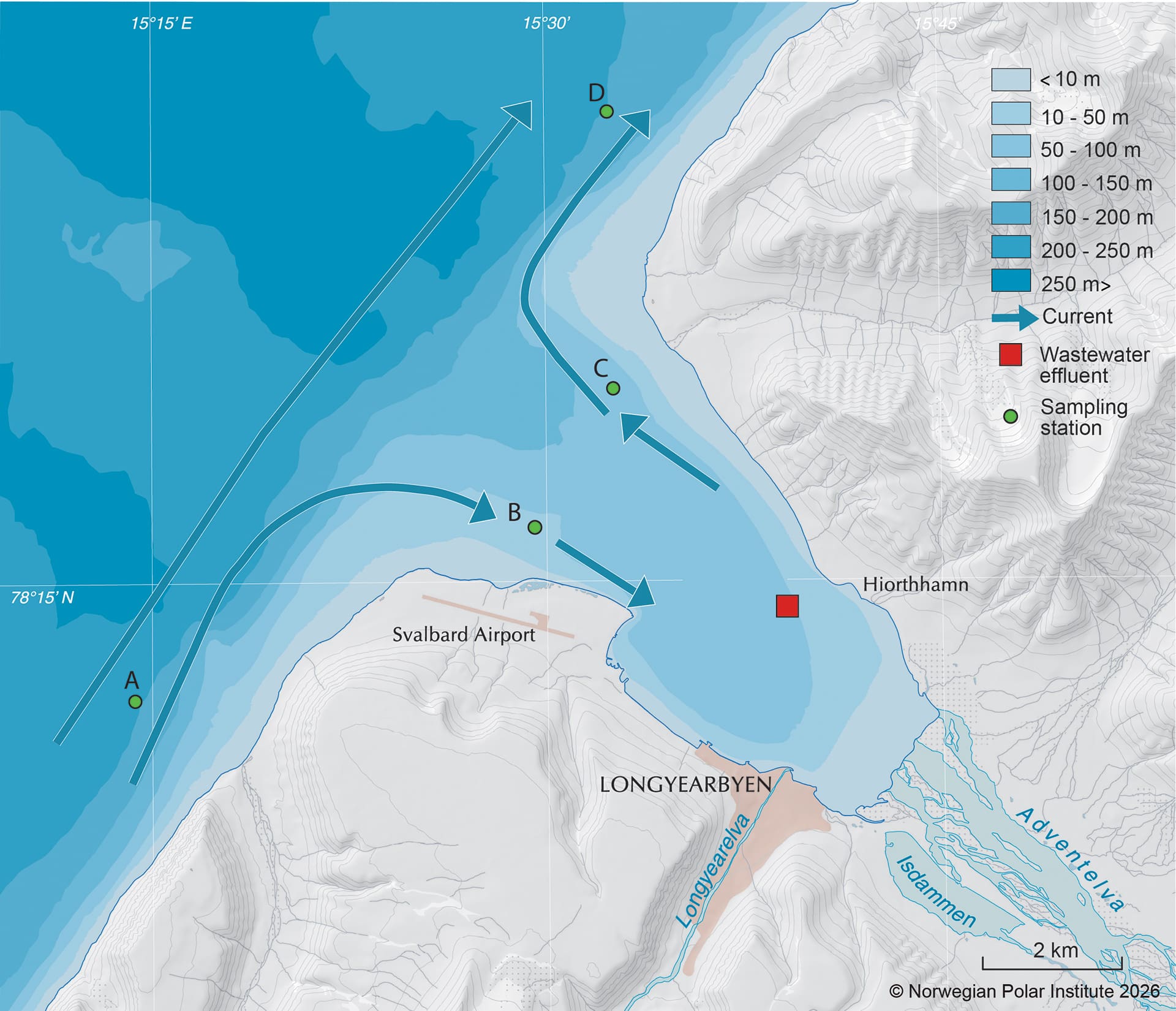
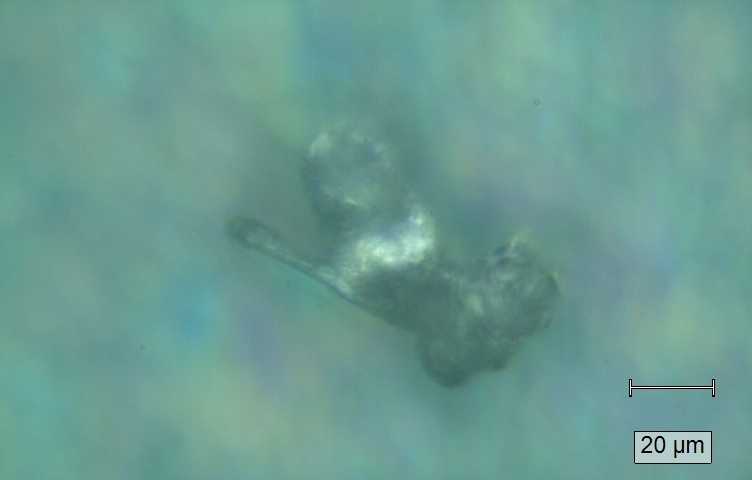
A previous sampling effort in 2017 showed that the number of manmade fibres in Longyearbyen’s wastewater was similar to that in treated wastewater from large cities, such as Vancouver, Canada. The same study employed a modelling approach to forecast the distribution of fibres in the fjord. Four years later, we conducted a new field study to compare fibre numbers in surface water with the model outputs, and to investigate the dispersal dynamics of anthropogenic (manmade) particles in Adventfjorden in situ and ground truth the model results. The particles, such as plastics, were further categorised by shape into fibres and fragments. We expected to find the highest concentrations of human-introduced particles in Adventfjorden closest to the wastewater outlet and Longyearbyen itself.
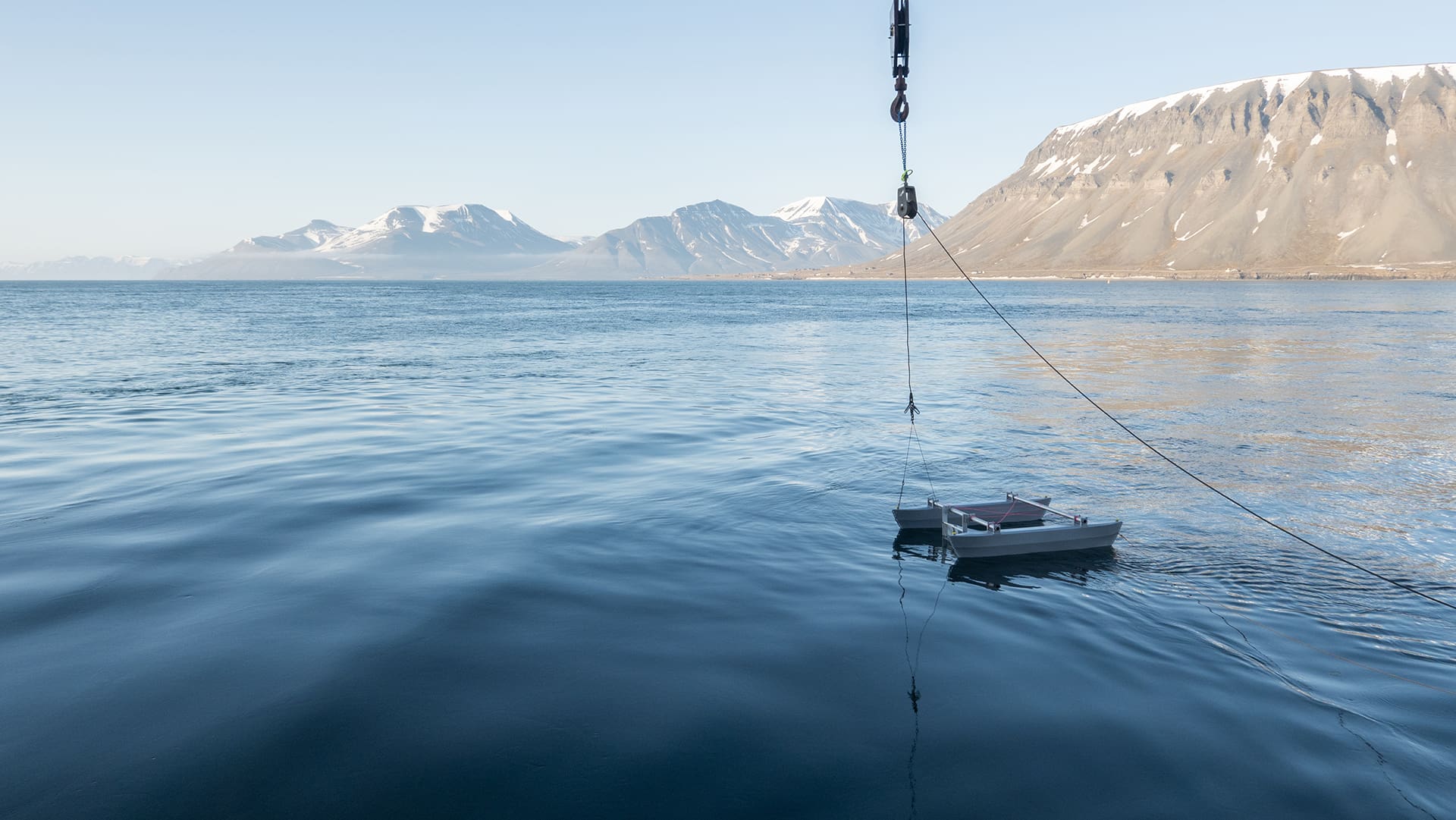
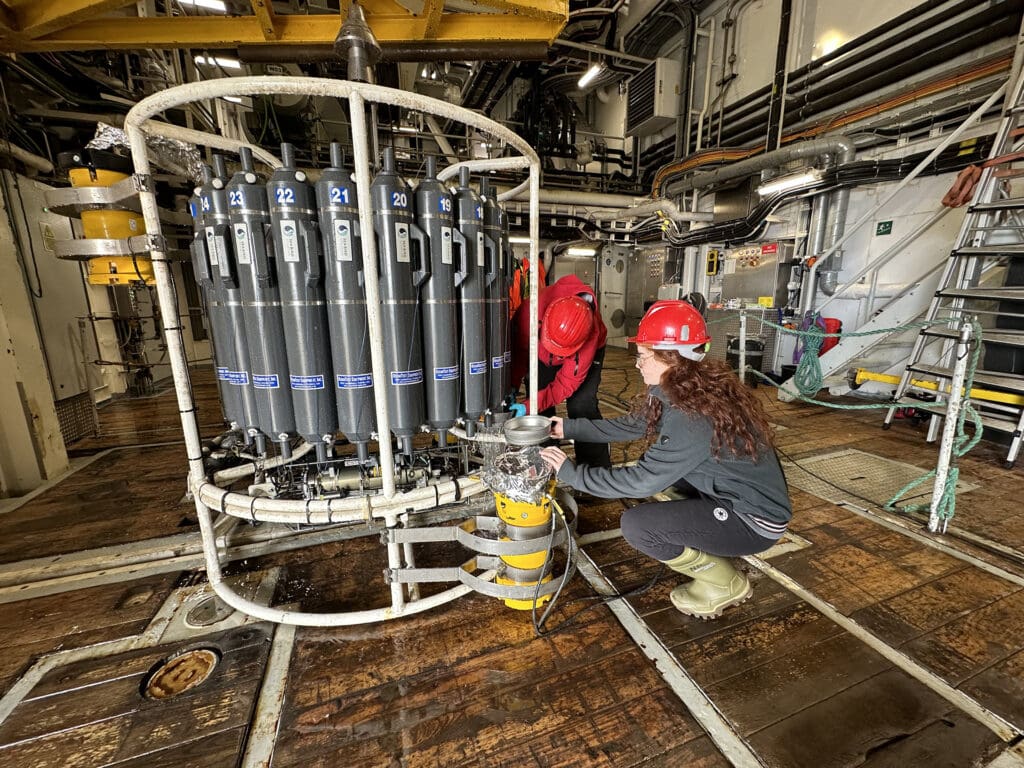
In June 2021, we sampled surface water at four locations: two at the inflowing current from Isfjorden, one near the untreated wastewater outlet from Longyearbyen, and one in the outflowing current from Adventfjorden into Isfjorden. The samples were taken with a CTD-rosette equipped with 10-litre Niskin bottles collecting water in the first 10-100 cm from the surface.
We found that the inflowing current in Adventfjorden is already burdened with anthropogenic particles. What we did not expect was to have more than double the concentration, as well as twice as many types of anthropogenic particles at sites before the wastewater outlet compared to after. Potential sources of this pollution in Isfjorden include Barentsburg (another Svalbard settlement), ship traffic in general (both tourism and shipping), as well as long-range atmospheric or oceanic transport from farther south.
So why did we not find a higher concentration of anthropogenic particles in Adventfjorden, where we expected to see local pollution in addition to particles from unknown sources, as predicted by the model? There are several possible explanations for these puzzling results. It is important to note that Longyearbyen and its wastewater system are known local pollution sources. The fact that we did not find higher concentrations close to the town, may be explained by the fact that we sampled only surface water and/or that the selected sampling sites in the fjord are affected by different oceanographic drivers. Our sampling campaign also provides only a snapshot of the particle burden. Good knowledge of how the water circulates in the fjord is essential to select a good sampling site. In Adventfjorden, we need to know how the circulation is affected by the seasonal rivers, especially the large Advent River, as well as whether sea water is driven by tides or by background circulation impacting the mixing of the water column. Others have pointed out that river plumes push anthropogenic particles ahead of them, effectively ploughing the surface water clear of such materials. We also know that due to density differences some particles will sink below the freshwater layer. The local pollution will also fluctuate by the time of day and the day of the week, corresponding to human activity levels.
For future sampling to quantify and monitor local pollution it is very important to be able to measure the local pollution, and to differentiate between local and long-distance sources. To get reliable data on local pollution from sea water it is vital to know the circulation pattern on a seasonal scale as well as the influence of river run-off for the site in question.
To conclude, Longyearbyen is a local source of anthropogenic pollution in Svalbard, though it is hard to put a number on the magnitude due to changes during the day and along seasons. In the future, ecotoxicologists and oceanographers need to cooperate on robust sampling strategies to gain better knowledge and monitor local pollution.
Further reading
Herzke D, Ghaffari P, Sundet JH, Tranang CA, Halsband C (2021) Microplastic fiber emissions from wastewater effluents: abundance, transport behavior and exposure risk for biota in an arctic fjord. Frontiers in Environmental Science 9: 662168,
Philipp C, Collard F, Halsband C, Herzke D, Vitale G, Corami F, Husum K, Gabrielsen GW, Hallanger IG (2026) Microplastic and other anthropogenic particles in surface waters of the Isfjorden system (Svalbard). Environmental Pollution 390: 127563,