

Overfishing of species that prey on sea urchins has led to an ecological imbalance along the north Norwegian coast. Without these predators, sea urchins multiplied, turning once thriving kelp forests into vast “urchin barrens”. Restoring predatory Atlantic wolffish could be the key to reversing this loss.
By: Marianne Frantzen and Trude Borch // Akvaplan-niva
Camilla With Fagerli // Norwegian Institute for Water Research
Brian Tsuyoshi Takeda // Restorae
Øyvind Stråbø // Trefadder
Erling Natvig // Vår Energi
A natural sea urchin predator
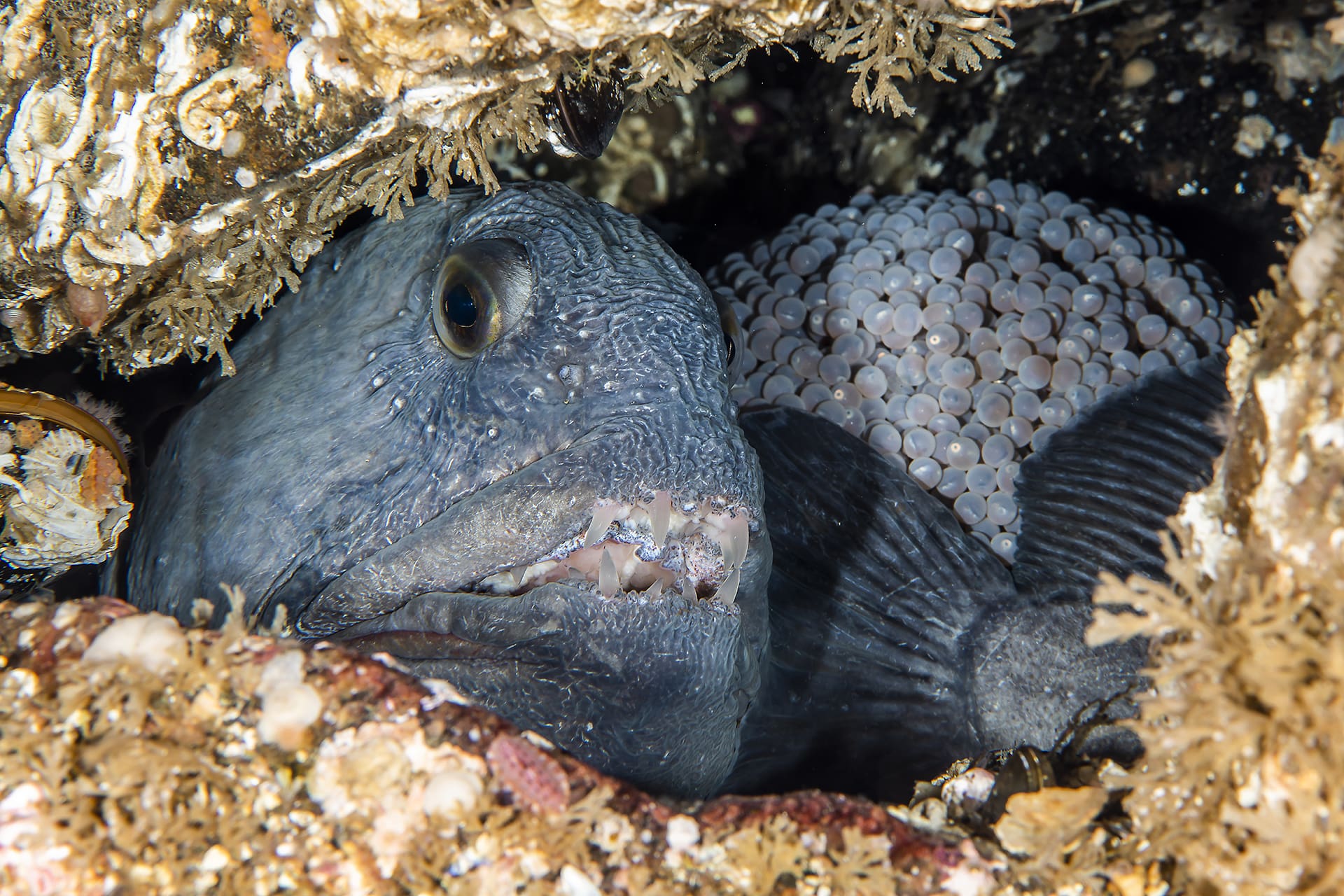
The Atlantic wolffish (Anarhichas lupus) is a relatively stationary bottom-dwelling species commonly found along the entire Norwegian coast, typically at depths shallower than 150 metres. It mainly feeds on sea urchins but is also partial to mussels, snails, and crabs. The species reaches sexual maturity at 6–7 years of age and it can live up to 25 years.
During the spawning season, male and female wolffish pair up and remain together at the spawning site until spawning. Unlike most other fish species, Atlantic wolffish has internal fertilisation. After the female lays her eggs, the male guards the egg mass for 9–10 months until hatching—a rare example of extended parental care among marine fish.
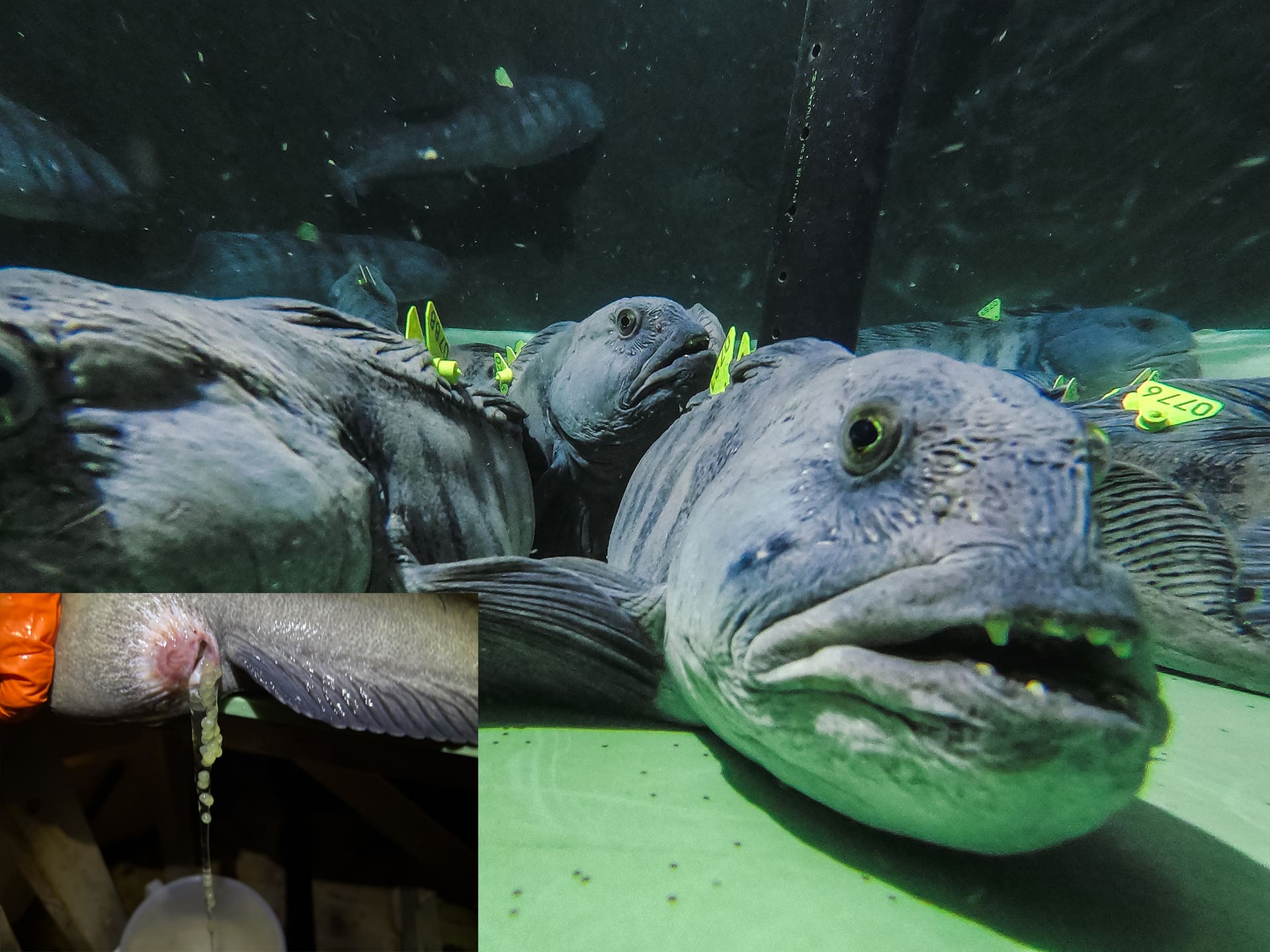
In captivity, natural mating behaviour does not occur, so artificial fertilisation techniques must be used. Females are briefly removed from the water, anaesthetised, and stripped of eggs, which are then fertilised with milt taken from males. The eggs are incubated in seawater tanks where they adhere naturally to one another as they develop.
Restoring ecological balance
Small-scale experiments have shown that removing sea urchins allows kelp to regrow quickly. But without continuous management, urchins rapidly recolonise and destroy the new growth. In other parts of the world, maintaining populations of sea urchin predators—fish, crabs, or lobsters—has proven vital for long-term kelp recovery.
Along the north Norwegian coast, areas where larger predators like the edible crab (Cancer pagurus) or king crab (Paralithodes camtschaticus) have become established (i.e. Nordland south of Lofoten and in some fjords in the north of Finnmark, respectively), we have seen sustained kelp regrowth. However, in much of the coastal areas of Troms and Finnmark, there are too few sea urchin predators such as wolffish, cod, haddock or large crabs to maintain this balance.
Given its feeding habits and adaptability to northern coastal environments, the wolffish appears to be a promising candidate for reintroducing natural “top-down” control of sea urchins. A restored kelp forest, in turn, would provide breeding and nursery habitat for cod, haddock, and many other species that depend on a healthy kelp ecosystem.
The BlueRewilding Project
The BlueRewilding project—funded by Restorae and Trefadder/Vår Energi—aims to strengthen predator populations and promote lasting restoration of kelp forests in northern Norway. The project focuses on developing techniques to produce juvenile wolffish, including larval start feeding, juvenile growth monitoring, and adaptation to sea urchins as prey. The goal is to produce 500 release-ready fish for field trials.
In June 2025, Akvaplan-niva and NIVA collected 30 wild-caught Atlantic wolffish to serve as broodstock at Akvaplan-niva’s research station outside Tromsø in northern Norway. Using experience from the long-standing research and breeding effort on spotted wolffish (Anarhichas minor) at Akvaplan-niva, researchers have successfully transitioned the wild-caught Atlantic wolffish from sea urchins to dry feed. The first female spawned on 10 December 2025, and during the following month the remaining females spawned. Fertilised eggs are now being incubated, and hatching is anticipated to take place in early summer 2026.
Beyond wolffish production, the BlueRewilding project will collect genetic samples from wild Atlantic wolffish populations in four to five fjord and coastal areas near Tromsø. These data will support future population management efforts. Applications for release permits are also being prepared, along with studies to determine the optimal release size, age, and frequency of wolffish releases needed for large-scale restoration.
Healthier coastal ecosystems
By reintroducing the Atlantic wolffish as a key predator, the BlueRewilding project aims to restore ecological balance and resilience in kelp-dominated coastal ecosystems. Healthy kelp forests not only support marine biodiversity but also store carbon, reduce coastal erosion, and sustain valuable fisheries, making this effort an important step toward revitalising the underwater forests along the coast of Arctic Norway.