

Did you know that stairstep moss can be used as a sampler for air pollution? Researchers at NILU have collected this kind of moss on several occasions and examined it for metals and other pollutants.
By: Tore Flatlandsmo Berglen, Christine Forsetlund Solbakken and Hilde Uggerud // NILU
Jenny Jensen and Guttorm Normann Christensen // Akvaplan-niva
Tone Roksvåg Aandahl // Norwegian Institute of Bioeconomy Research (Svanhovd)

Stairstep moss (Hylocomium splendens) is commonly used as an indicator plant for the deposition of air pollution. It has no root system and receives all its nutrition from precipitation and deposition through air.
As a pollution sampler, stairstep moss needs neither electricity nor supervision. It forms a new “stairstep” each year, making it easily identifiable in the field. This growth pattern also makes it easy to find out which years each plant represents.
The moss method
This technique of using moss for investigation of environmental pollutants was first proposed in 1968 by Åke Rühling and Germund Tyler at Lund University, Sweden.
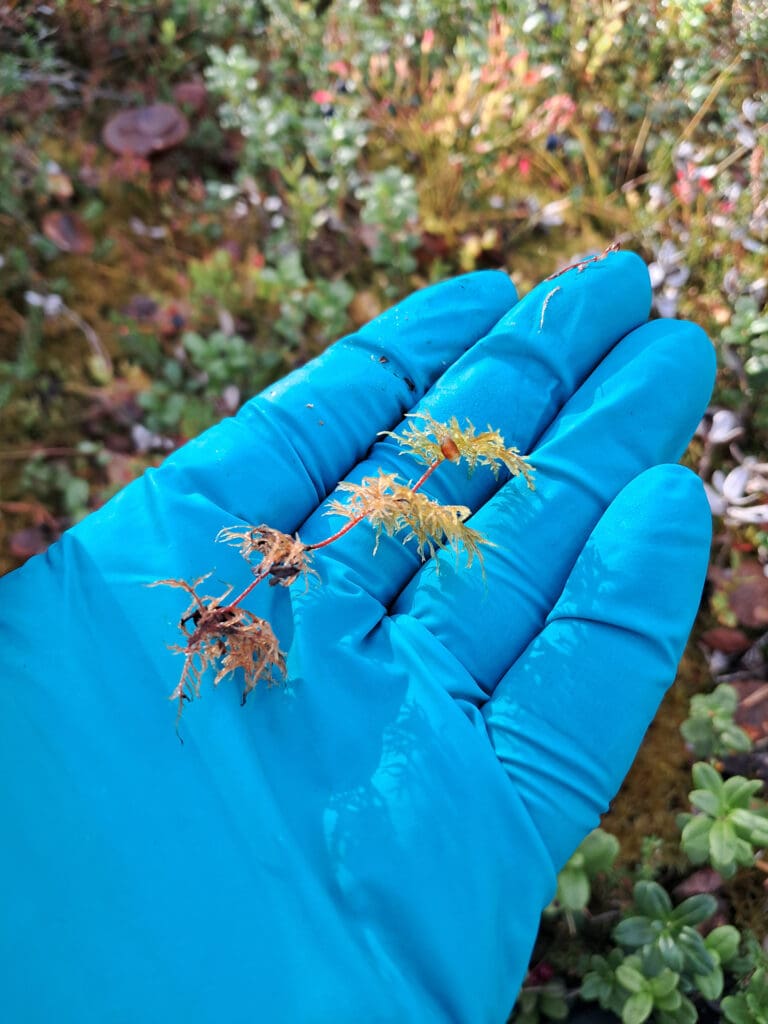
The method is simple; moss is collected, dried, manually cleaned of debris and other moss species and then analysed for pollutants. By comparing results from different locations, one can obtain an overview of the deposition of pollutants through air and precipitation over the last 2-3 years.
In other words, the moss is a simple and cost-effective sampler for pollution, providing a good estimation of the pollution at a specific location. As mosses are found virtually everywhere, moss is particularly well suited for studies of pollution on both local, regional and European scale if various stations with good geographical distribution are chosen.
European moss survey
ICP Vegetation is a long‑running, coordinated European biomonitoring programme. It uses mosses to map atmospheric deposition of pollutants across roughly 25–35 countries every five years.
The project focuses on heavy metals, nitrogen, persistent organic pollutants (POPs/POP‑like substances) and, more recently, microplastics, using harmonised field and analytical protocols.
The ICP Vegetation (International Cooperative Programme) is an international research programme investigating the impacts of air pollutants on crops and (semi-)natural vegetation.
It reports to the Working Group on Effects of the United Nations Economic Commission for Europe Convention on Long-Range Transboundary Air Pollution.
The programme focuses on the impacts of ozone pollution on vegetation and the atmospheric deposition of heavy metals, nitrogen and persistent organic pollutants to vegetation.
National monitoring programme
From 1987 until 2015 Norway had a national moss survey programme. This was a collaboration between the Norwegian University of Science and Technology (NTNU) in Trondheim and NILU and was led by Dr Eilif Steinnes. The number of stations varied, and in the last study year (2015) stairstep moss was collected from 230 locations and analysed for 56 different elements. Altogether, the moss survey programme constitutes an incredibly valuable time series for inputs of environmental pollutants from 1977, 1985, 1990, 1995, 2000, 2005, 2010 and up to 2015.
The national programme ended due to lack of funding, but the sampling and analysis was repeated for Finnmark County in 2020, and the results were published in ICP’s Vegetation report.
In 2025, the Svanhovd branch of the Norwegian Institute of Bioeconomy Research (NIBIO Svanhovd) collected soil samples all over Norway. This tour was part of the monitoring of radioactivity after the nuclear accident in Chernobyl in 1986. The soil stations coincide with the former moss stations, and stairstep moss was collected in Troms and Finnmark Counties for future analysis.
Moss sampling near industrial sites
Between 2000 and 2015 NILU and NTNU conducted a moss survey of atmospheric deposition of heavy metals around industrial enterprises in Norway. In 2015, 22 industries located at 17 different sites financed their own participation. During the initial participation, samples were collected from ten measurement points around the industry to obtain a comprehensive picture of the dispersion pattern. In subsequent participations, samples were taken from the five most informative measurement points.
In general, the results showed that deposition of heavy metals close to industrial sites is related to the industrial processes used. The pollution is often deposited locally since the metals are associated with particles.
Akvaplan-niva and NILU have a joint project for Equinor at Hammerfest LNG. Moss is one of the environmental indicators investigated in the project.
Border region towards Russia
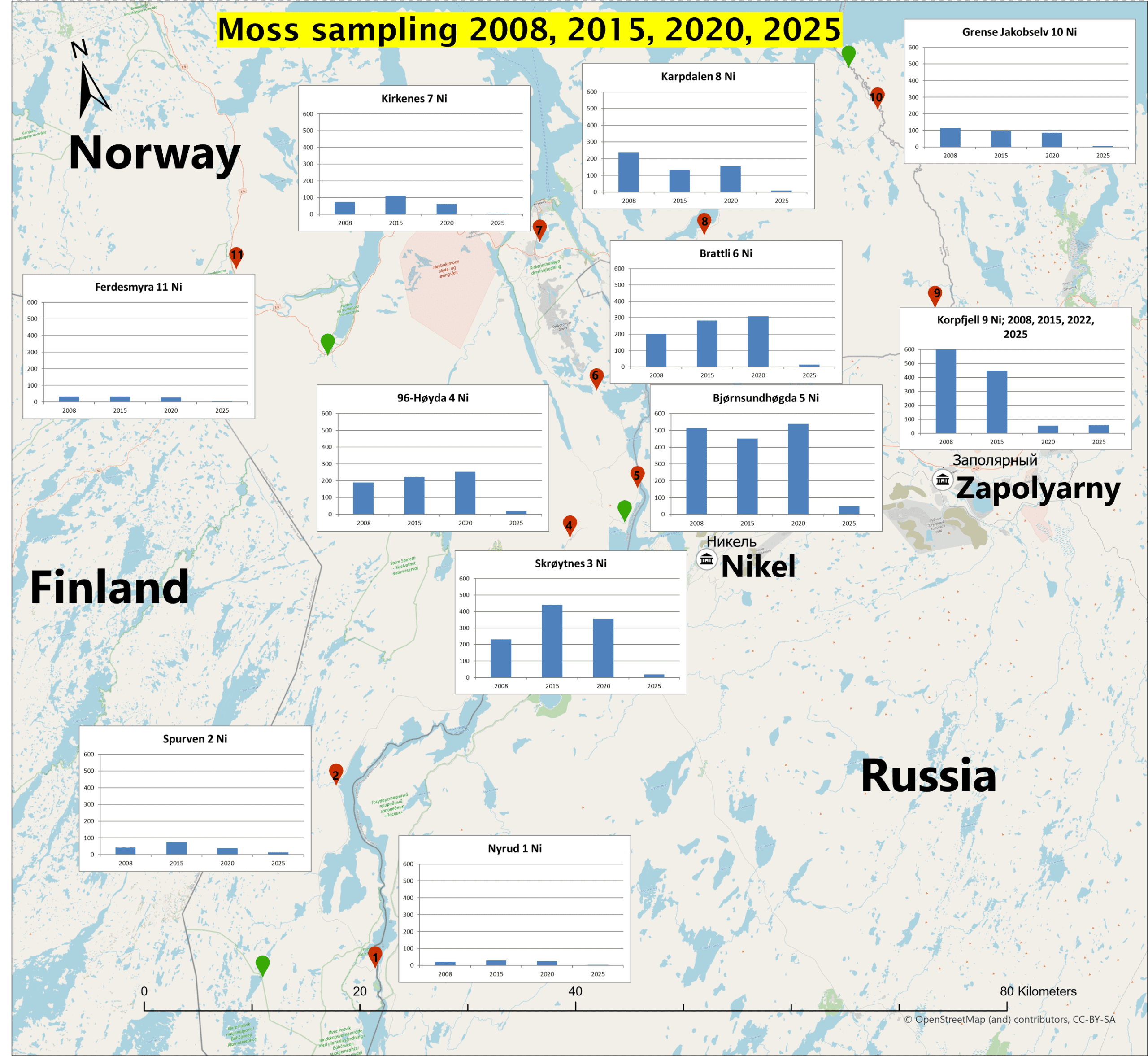
In 2008, NILU and NIBIO Svanhovd received funding to collect stairstep moss samples from eleven stations along the Norwegian-Russian border. The aim was to investigate contribution from smelter activity in the towns of Zapolyarny and Nikel close to the border, with emphasis on the trace metals nickel, copper, cobalt and arsenic. The prevailing wind direction in the border areas is from the south during winter. The eleven stations were carefully chosen based on meteorology and distance from the smelters; two stations were located upwind of the Russian smelters, four stations were located close to Nikel, two stations were located close to Kirkenes, two stations were located downwind, and one station was used as background.
The sampling was repeated in 2015, 2020 and 2025. The results for nickel clearly illustrate how pollution from the smelters affects the surrounding areas, both close to the smelters and downwind.
The Nikel smelter ceased operation in December 2020, when the production was moved to Monchegorsk, 150 km south of Murmansk. And the moss analysis clearly shows a sudden and abrupt decrease in pollution levels between 2020 and 2025. For the stations close to Nikel, the concentrations of nickel decreased by 90–95% from 2020 to 2025.
The take-home message
- Stairstep moss (Hylocomium splendens) is a very reliable and cost-effective biomonitor of air pollution, especially for metals.
- Both national and international moss surveys provide long and valuable time series for air pollution, from the 1970s until today.
- Even though the national moss survey stopped in 2015, the sampling continues in the northernmost counties Troms and Finnmark, and along the Russian border.
- The moss sampling programme in the border areas towards Russia shows a sharp decline in the concentrations of nickel, copper, cobalt and arsenic after the Nikel smelter shut down in December 2020.
Further reading
Berglen TF, Uggerud HT, Schlabach M, Enge EK, Bjørklund M, Pfaffhuber KA, Aandahl TR, Fjelldal E (2025) Metaller, PCB, PAH og dioksiner i mose i Sør-Varanger. Moseundersøkelser 2008, 2015 og 2020 (NILU rapport 2/2025). Kjeller: NILU, (Available only in Norwegian)
Hayes F, Sharps K, and participants of the moss survey (2025) Mosses as biomonitors of air pollution: 2020/2021 survey on heavy metals, nitrogen and POPs in Europe and beyond. Report of the ICP Vegetation Coordination Centre, UK, 134 pp. ISBN 978-1-906698-92-8,
Acknowledgement
Funding sources for moss sampling include the Norwegian Environment Agency, the Ministry of Climate and Environment, the Interreg Aurora project Our Precious Waters and Equinor Hammerfest LNG, in addition to internal funding from the project partners.